Wednesday, November 20, 2019

A Million Miles to Zanadu


A Million Miles to Zanadu


(Lok Sabha Debates Pollution)


The long-awaited sleeping giant ‘Gulliver’ has stirred; but my compatriot ‘Lilliputian’ campaigners remain sceptical. Having dared buzz around the somnolent ‘giant’ Gov of India; the irritating mosquito that refuses to go away, has finally stung; but nothing’s changing for now. 


Zanadu is still a million miles away.


Yet the Lok Sabha debate on Pollution yesterday is a watermark of sorts, ushering in phase 2 of India’s environmental governance; a realisation by the lawmakers that there may be an environmental crisis, which till now had been rubbished by the establishment as a fad of the jhola wala’s and few urban elites. In fact, Minister Housing & Urban Affairs Hardeep Puri went as far as labelling them as ‘mischief mongers’, creating obstacles in ‘Development’; Environment Minister Javadavekar, famously said, cut trees here and plant them elsewhere, what difference does it make!!


The Pollution debate yesterday itself may have been a high point; disappointing however was the low attendance, perhaps just a fifth of the house of 543 members, the quality of the debate tepid, only refined in bits by known environmental lawyers Pinaki Mishra and Manish Tiwari. A boost in the arm of the Clean Air campaigners was the discovery of Gaurav Gogoi the suave soft spoken, no nonsense MP from Assam (Congress) who articulated his views in extenso with conviction.


It is not without reason, politics and mudsling is spoken in the same breath. For mudslinging the honours certainly go to BJP, both on the floor of the House (Manoj Tewari) and on TV debates, where their sole agenda has been to denigrate AAP. Their fulminations and raves being without substance however, is doing more damage than good to their party, the sooner they realise this, the better for them. The surprise element was the appearance of ‘Jalebi’ Gaurav Gambhir, who made a faltering rehearsed statement, on how pollution affects everybody! Ho Hum, now tell me another! The MP has learnt something beyond: “You Bowl, I Bat….”


Good environmental governance may now mean good politics; politicos are realising they can get eyeballs speaking environment and don’t want to miss jumping the bandwagon; yet remain duplicitous; simultaneously giving tree cutting permission for a few million trees for a faddist ‘Bullet Train’. It’s still a long way before the lawmakers stop running with the hares and hunting with the hounds; and start to speak from their heart, and act with conscience. Since the winds of change is apparent, even the hardened critics of ‘environmentalists’; as our tribe is deprecatingly labelled; are talking a different language. 


Indubitably, it is the tireless efforts of good environmental governance campaigners who have finally managed to engage a contemptuous Government of India in a conversation on Air. Most of the campaigners have worked relentlessly over the years to bring Air Pollution on the CenterStage, and continue with evangelical fervour. And there are many of them, working silently preferring anonymity, extremely recalcitrant on appearing to be the ‘Leader’ of such a movement. 


For now, a conversation within Parliament and Government has begun. Civil society that has spearheaded this awareness is still excluded from joining the debate, as their presence will open a pandora’s box of neglect, apathy and sheer callousness. Yet, it’s a matter of time the box will be pried open, and the skeletons emerge. The nation faces its greatest challenge, and its time all hands came aboard!


Tuesday, April 16, 2019

*Don’t shoot the messenger*

*Don’t shoot the messenger*

The school strike by children for climate action has attracted widespread attention across the globe. India joining the fray has begun to make its presence felt in an otherwise apathetic stonewall system attuned to pontificating but not listening.

But as usual, the forces that raise their voice get the flak. In a classic example of shoot the messenger, the kids movement India is being phoo-phooed as fad of the rich kids. Ironically the kids are being asked to walk their talk on climate aggravation and turn vegetarian or stop riding in diesel vehicles.

Whilst the entire planet has indulged in climate profligacy, belched carbon for two centuries,  massacred rain forests and assembly line produced meat, a handful of kids are being asked to walk their talk.

So herein lies the true narrative; in the face of the unstoppable onslaught on environment; and the opposition being mere arrows  to oppose supersonic forces; destiny has thrown up *Children* as its last weapon to save the planet. The narrative is to force policy makers to change, and change really fast before its too late.

The kids have taken up cudgels where grown ups have failed. The platitudes of governments doesn’t impress them. The banal statements emerging from the Paris Accords or World Economic Forums doesn’t mean much when the planet is facing extinction.  They want change and they want it now.

The saviours of the planet have arrived, they will lead, we will follow. In the meantime, don’t expect them to turn Puritanical to pursue the cause, to eschew while we gorge,

Real action on Climate has begun, we’ve brought out our last  round of ammunition. Succeed we must or face annihilation. Meanwhile, 
*don’t shoot the messenger*

Sunday, June 4, 2017

Nationhood and Patriotism

Nationhood and Patriotism

At the creation of our nation the two were indivisible; synonyms to each other; Nationhood and Patriotism.

70 years of independence and complete security from foreign invasions has lulled the country into compartmentalising the synonyms. Nationhood stands on a separate pedestal, and patriotism? ‘Well, yeah that too’

The departure of patriotism from the national discourse is the first sign of a nation in decay. So, what is nationhood? A nation is variously described as:

‘A large group or collective of people with common characteristics attributed to them; including language, traditions, customs habits and ethnicity. It is a cultural-political community that has become conscious of its autonomy, unity, and particular interests’.

Or:

"A nation is a soul, a spiritual principle. Two things, which in truth are but one, constitute this soul or spiritual principle. One lies in the past, one in the present. One is the possession in common of a rich legacy of memories; the other is present-day consent, the desire to live together, the will to perpetuate the value of the heritage that one has received in an undivided form", "A nation is therefore a large-scale solidarity"


A nation therefore is an amalgam of people of common heritage, common shared ideology, and a desire to lead a particular way of life through social and political action. This does not allude an amalgam of people boxed into a narrow minded, parochial, insular discourse; rather people so diverse; yet conjoint by a cord of shared  ideals; of thought, action, and practice.

This is nationhood.

This is India; so diverse in ethnicity, religion, social habits, political ideology, yet so united by common cherished ideals of Secularism, Freedoms and Rule of law; the Doctrine of Egalitarianism in which fairness permeates every section of society and life.

Then what is Patriotism?

Patriotism is devotion to one's own country and concern for its being. When the liberties of our country, the freedoms of our Constitution, borders of the nation are worth defending. Patriotism is when your heart swells at the name of your country; when your eyes get moist whilst singing the National Anthem in a cinema hall; when viewing ‘Beating Retreat’ makes you burst with pride at listening to ‘Sare Jahan Se Accha’  your nation, your country. This is patriotism.

So where do Nationhood and Patriotism conflux? Is there a convergence point of the two? The truth lies somewhere in the centre; each one is so interdependent on one another, that each without the other is an empty shell. It is the heart and lung of our being; a body cannot survive without the heart and lung being in complete synchronicity with each other. So be it with nationhood and patriotism.

Cutting to Today. A reality check;

The space for liberals is fast narrowing, a nation transfixed in its energies to cow vigilantism, patriotism have now become an extension of demagogy, intolerance; the true ideals of Nationhood and have been pushed into dusty recesses of our minds. A complete apathy for the lives being laid down by the Army at our borders, or Para Military combating the Marxists in the Red Corridor with a common refrain, ‘Well they are meant to do that’ or, ‘look at the good perks the services enjoy’. Effectively the nation has subcontracted is Defence to an opaque structure called the Armed Forces, and indifference beyond that.

No wonder on a memorial for our martyrs; we witness farcical platitudes and clichés, callous indifference and apathy, a section of disputatious citizenry who create mayhem to pursue their narrow pedantic agenda. No wonder we witness cattle being put on the centre stage of governance, and brave hearts who defended and died for the nation being consigned to cattle class.

When Patriotism dies, a Nation is bound to fail.

rajeevsuri.cbms@gmail.com


Thursday, June 1, 2017

World Environment Day 5th June 2017


The notion that we must conquer or dominate nature has governed human behaviour for a relatively short period of our 150,000-year history on this 4.5-billion-year-old planet. It's an understandable impulse. Our intelligence and foresight allowed us to develop complex societies, and gave us a sense of control over our existence in the face of powerful, often threatening natural forces.
Unfortunately, our lack of attention to the intricate and interconnected ways of nature has led to widespread devastation that now threatens the very systems that support human health and survival. We have become disconnected from our own true nature.
The more science reveals about the natural world, the more we learn what many indigenous peoples have long known: that everything is interconnected and interdependent -- from the tiniest microbes to the largest carnivores, from plants that sequester carbon, prevent flooding and feed us to the carbon, hydrologic and other large cycles that keep the planet in balance.
There's no going back to simpler times, but our survival does depend on respecting our place in this miraculous world. To heal the disconnection, we must reconnect. It's fitting, then, that the theme of this year's World Environment Day on June 5 is "Connecting People to Nature."
Renowned American ecologist Edward O. Wilson used the term "biophilia" to describe the innate kinship people share with all other life forms. Because we are more likely to care for the things we love and see as important, we must rekindle this biological imperative if we are to protect the biosphere that keeps us healthy and alive.
How do we accomplish that when many of us are moving further from our natural connections daily -- when more than seven hours in front of a TV, computer or smartphone screen, and when many adults spend their days driving to and from work where they sit in front of computers for hours on end?
Understanding the benefits of time in nature is a start. Studies show time outdoors can reduce stress and attention deficit disorder; boost immunity, energy levels and creativity; increase curiosity and problem-solving ability; improve physical fitness and coordination; and even reduce the likelihood of developing near-sightedness!

Wednesday, November 30, 2016

An open letter to Aditya Puri, MD HDFC Bank


Dear Mr. Puri,

I write to you as an account holder with HDFC Bank. I write as any other distressed citizen swept in the mania unleashed on the country due to the whimsical behaviour of one individual. Needless to say, there is no looking back; the bullet has left the barrel, but has wavered on its path, and has not hit its target.

Can this happen? Can a bullet leave its barrel and go wayward on its journey? Well we are witnessing something along those lines; the initial expectation of a quick fix solution, or to use a term that has become common parlance, 'surgical strike', has not been met, is seems to have become a battle, a war if you like, and however harsh it may sound, will not be met for a long, long time.

In the meanwhile, it has resulted in immense hardship on the citizenry. The rural un-banked 50% of the population have particularly very badly affected and we empathise with their misery. Horror stories abound, some reported, others being passed by owing to the growing apathy to the misery stories.

In other words, plainly speaking, the 'apple cart has been upset'. This country is undergoing a pain as never before. However induced myopia of a recalcitrant administration advises eat cakes, if there is no bread; translated use debit/credit cards if no cash. As a HDFC account holder I regularly get messages from you, Mr. Managing Director, on the steps your bank has taken to go digital, and how we ought to use such digital initiatives. However, ATM's are dry, counters have no cash, queues long and winding; hence the question;

Am I really an HDFC customer??

All the effort made by yourselves towards relationship banking has come to nought. Since current rules dictate no differentiation between Tom Dick or Harry, as an account holder we too have been swept with the broom of egalitarian justice. Imagine not being permitted into your own branch, or not being able to access a single Rupee. Such an ironical situation needs to be addressed by yourselves, I therefore venture to suggest HDFC should adopt a policy of 'All men are equal, but some are more equal'. This would mean a differentiated yet equitable policy towards HDFC customers. Instead of attempting to preach Christianity to the Pope, please understand your customers know how to use ATM's and Net Banking. What they need at this moment is the three C's Care, Concern and Cash.

Unfortunately, a hard pressed branch can only do so much and no more, which to their credit, are putting up a sterling performance. However customers seek to be treated as customers and given priority, treated deferentially, and needs serviced. 

HDFC has to do much more to continue relationships; customer is king and needs to be made to feel like one, even in times as such.

The ball vests in your court.

Sincerely,

Rajeev Suri

Sunday, November 27, 2016

Cognitive Dissonance and the Autocrat


Cognitive Dissonance and the Autocrat

You are a true Indian and a nationalist if you quietly stand in queues for withdrawing cash only to be turned back when your turn comes, or providing ID proof to buy subzi at Mother Dairy. We are reminded each day this is small pain in the larger interest of the country. So said every dictator in the world,


PM Modi's klaxon call Kala Dhan Hatao has a similar ring to PM Indira Gandhi 1971 election slogan was 'Garibi Hatao, desh ko bachao', both slogans cleverly crafted to strike emotional cords with the people of India. The current slogan will be consigned to oblivion just as the earlier one was, once the larger aim of the autocratic leader has been met.

History shows us Garibi did not leave this country, in fact it has festered, grown, become more profound, just as inequitable distribution of wealth has made the richer, much richer. Bank nationalization, coal nationalization, seizure of assets, and the 44th amendment of the Constitution withdrawing owning property as a fundamental right; were among the many draconian steps taken by Mrs Gandhi to impose state ownership over what was legitimately owned by an individual.

Currency demonetization is no different. Let’s look at the figures; experts agree 25 % of the GDP operates in the parallel economy; of this a mere 6% consists of cash, the rest is spread across other asset classes.

The spigot of black money is the rampant graft and corruption that runs across all political and bureaucratic genres. Eradicating the source of black money generation should have been the first recourse; rather than being left to posterity, if at all. With this spigot being left open, after the initial shock, new currency will start funding graft and corruption, and once again the black economy will spring alive, vibrant and active as before.

Hence to cleanse 6% of 25% of the black economy, 86% of money in circulation has been withdrawn. Imagine a human body in which 86% of the blood is removed, what would the outcome be? Withdrawing 86% of currency from a predominantly cash economy has left the country gasping, affecting the poorest of the poor the most. Thus, could eradicating Black Money been the only agenda?

 Prime Minister Modi is a case study in a psychology term cognitive dissonance, one who holds contradictory thoughts & beliefs simultaneously, and struggles to come to terms with such contradictions. One the one hand projecting himself on the world stage as a democratic leader with progressive ideas, his inner self draws him to whimsical use of regressive autocratic power. In a clear attempt to deflect the nation's attention from emerging situations, forthcoming elections, demonetization has been a used as a tool to consolidate power, emasculate the opposition, and gain laudation from the citizenry, who have been made to believe demonetization will ensure greater social justice.

Will it? 

 A poorly thought out decision of the unholy triumvirate that rule this country to consolidate autocratic power, demonetization will neither cleanse the country of the ilk of black money, nor corruption. It will however consolidate the class divide, the good and the evil; translated, the poor and the rich. Social justice will remain a distant dream, just as Garibi Hatao, Kala Dhan Hatao are slogans for limited personal ends, as Bob Dylan sang; will be ‘Blowin in the Wind’


The nation remains fooled.

Tuesday, August 16, 2016

Monsoon Morning

Nothing more beautiful than a monsoon morning!

The alarm went of with its precision calling, at 5.15, half asleep I lifted one eyelid, dawn had broken but the skies were dark. Our dog Boxy didn't stir, an indication that she had no intention of heading for a walk just yet.

A couple of minutes more in bed, and then a quick round of getting ready for the walk, Boxy's now all ready and geared up; and off we are.

What a glorious morning! Gentle breeze wafts the cheeks, silence rules the morning, the early birds chirp their way, the plants all seems so happy and cheerful;

 Cat Stevens epic number rings in the brain, all of 40 years after he sang; 'Morning has broken';

Morning has broken like the first morning, 
Blackbird has spoken like the first bird.
Praise for the singing, 
Praise for the morning, 
Praise for them springing fresh from the world.

And as one walks down the park and gardens that adorn our neighborhood, nature is in full glory, with each leaf shining so clean and fresh, the marvel of the monsoons knows no bounds, the grass of the wet garden under our feet gives a new prance and joy to Boxy, who's infectious happiness of being out in the open this glorious morning can but bring a smile, and Cat Stephen again;

Sweet the rain's new fall, sunlit from heaven, 
Like the first dewfall on the first grass.
Praise for the sweetness of the wet garden, 
Sprung in completeness where his feet pass.


Nature's infinite creation, the cool crisp air, the gentle rays of sunshine, each day, each morning, a new day, a new morning, always there, never failing to cheer, and start you day with a spring under your feet!


Mine is the sunlight, 
Mine is the morning, 
Born of the one light Eden saw play.
Praise with elation, praise ev'ry morning, 
God's recreation of the new day.


Monday, February 22, 2016

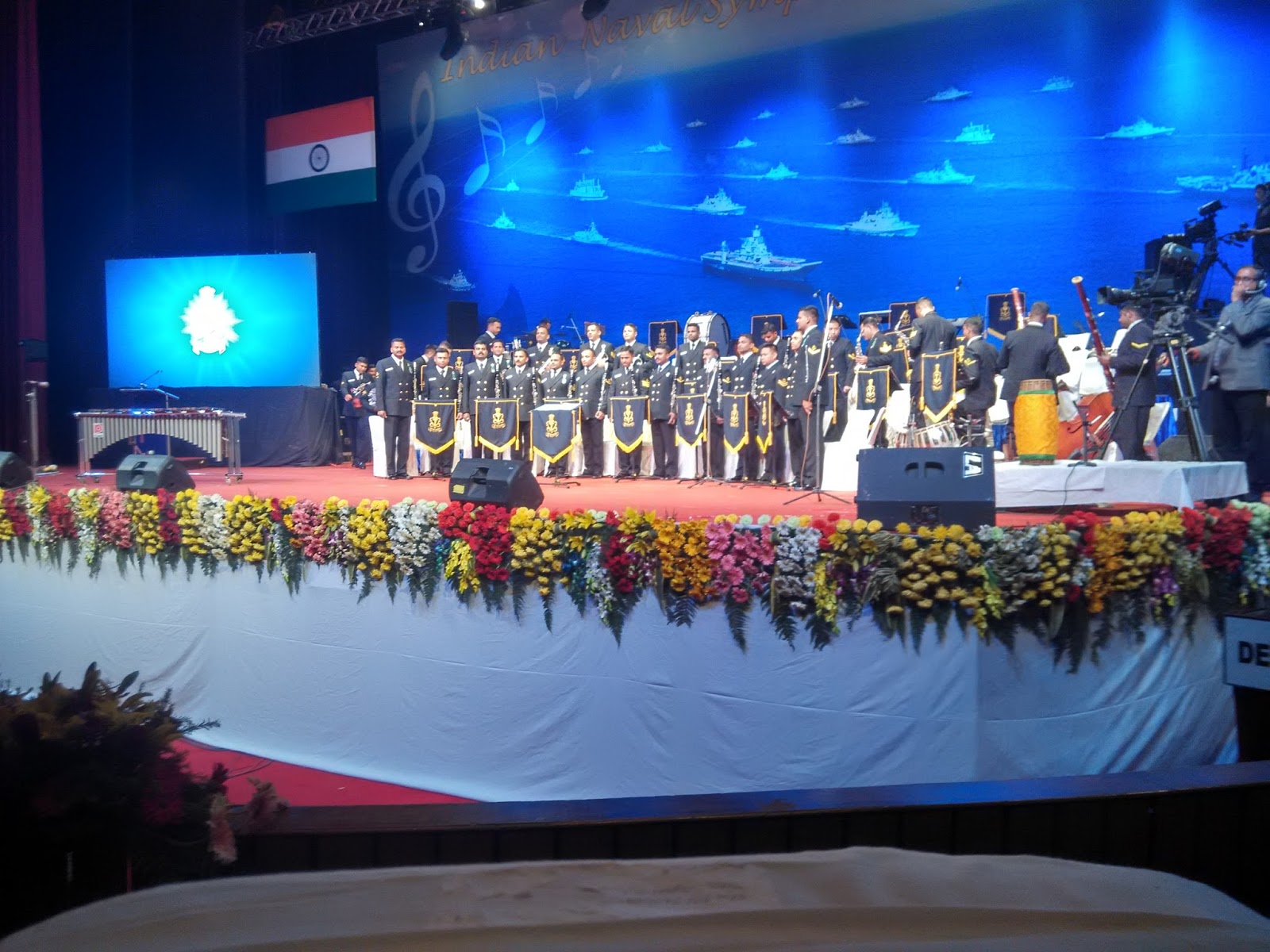
Indian Naval Symphonic Orchestra


The Indian Naval Symphonic Orchestra performed at the Sri Fort Auditorium at New Delhi on Friday, 19th February 2016, enthralling the audience with its repertoire of classical, contemporary and fusion Indian classical music. Attended by the State Defence Minister, Naval Chief , Naval Officers, other dignitaries from civil society, Military Attaches from various embassies, this was an extravaganza par excellence, a sound and visual delight.


Tuesday, February 2, 2016

‘Saare Jahan se Accha’


‘Saare Jahan se Accha’

    
      ‘Beating Retreat’ 50 years ago; Circa 1966

My chest swelled with pride,
As the combined bands of the Army, Air Force and Navy come marching down Raisana Hill, resplendent in their ceremonial attire playing ‘Saare Jahan se Accha’, I’m consumed with a sense of intense patriotism; our country, our armed forces. I cast a sideways glance, my brother’s transfixed gaze displayed the same emotions; my mother sitting beside me on the other side sees my eyes shining and presses my hand, gently; smiling knowingly; my father seated beside her resplendent with his medals, looked the grandest of them all.
I felt my chest is going to explode.
Sitting on the stands especially erected for ‘Beating Retreat’, at Vijay Chowk or victory square, a vast quadrangle as you descent Raisina Hill where the presidential palace Rashtrapati Bhawan is located, listening to the military bands, marching, playing, approaching; all in perfect unison, seated behind the President of India and three Chiefs of Staff, the services officers, heads of missions, dignitaries, foreign guests, was just much of a heady cocktail for a 12 year old! The majestic and imposing Rashtrapati Bhawan, looked every bit the seat of power of the erstwhile imperial power, now a symbol of India’s democracy. The sheer grandeur of the ceremony awe-inspiring and breath-taking, a sight and an event that remains etched in my memory forever, a dream called India.
Such a grand function, and I wonder why it’s called ‘Beating Retreat’. Officially meant to mark the end of Republic day festivities, its historical significance meant the end of battle with the enemy for the day, has now been morphed into a display of pomp and show, of our rich military heritage. The marching bands of the armed forces with a mix of instruments of bagpipers and drums, buglers and trumpeters, cymbals and trombone, bandmaster casting their mace high in the sky, only to catch it as it descends with one hand, without a flicker of the eyebrow, all creating music of a unique genre, a unique heritage of our military past. Marching in tandem, interweaving themselves in intricacies of U turns and rearrangements of the marching order with the practiced ease of a Sunday morning walk, in an array of movements and instruments, the bands regale the audience, spellbound in the sheer spectacle of the event. As the music regales, time flies, if only time would stand still, and the Retreat not end, but yet it must, that is the essence of the ‘Retreat’, it must end.
The drums solo begins; beating the bass drum and clicking the drumsticks in unison, my mind goes back to my history lessons when the cavalry marched into war and bands gave the beat to maintain rhythm. The end must be approaching.
The sun starts setting, a silence descends, the buglers begin playing ‘Abide with me’ to pin drop silence. An eerie calm descends on the spellbound audience, the bells tolls from the minarets of Rashtrapati Bhawan the National Flag is lowered and folded with reverence, a symbol of our Republic. As the bells stop tolling, the bands begin marching back up Raisana Hill playing ‘Saare Jahan se Accha’, magically Rashtrapati Bhawan is illuminated, bringing the celebrations to a perfect ending. The President’s Buggy rolls in with the sound of the clip clop of the horses’ hooves, I feel a pang of regret, its over till next year.
Present Day 29th Jan 2016; Time 4.45
I awake with a jolt, I must have dozed off whilst reading TN Ninan’s ‘Turn of the Tortoise’ a brilliant treatise on how the slow India, the proverbial tortoise is now getting its turn in the world, coming of age as a Breakout Nation. Often enough whilst reading I slip into a reverie, now reading Ninan’s Tortoise a heady jumble of dates, periods and numbers, crunched data of India’s post-independence development, juxtaposed with events, dates. I recount the India of yesteryear, when the young Indian nation had dreams and visions, hopes and aspirations, pride and valour, of gallantry and chivalry all coming together, inseparable in a heady mix of patriotism. Somehow, through this fascinating reading, I feel I’m the hero of the book since I’ve lived through those years and felt all those emotions, in totality what we’d call patriotism.
I ask for a cup of coffee and begin devouring ‘Tortoise’ again. A few pages later I’ve slipped back into my reverie; back to being 12 years old, on the stands of Vijay Chowk watching the ‘Retreat’ with the familiar strains of the ‘Saare Jahan se Accha’ ringing in my ears. The bands gets louder, and louder, the music seem to be right there, I snap out of my reverie and look up, the television screen come sharply in focus, and the ‘Beating Retreat’ of this year is in progress. It’s not circa 1966, I’m not 12 years old seated in Vijay chowk, but watching the ‘Retreat’ on television at home; I look out at the crowds on television, I could be any one of the 12 year old there on the stands. Emotions overtake me, I choke with intense nostalgia, patriotism, my chest swells up in pride…………
Sixty Nine years after Independence we live the dream called India. The Beating Retreat brings into sharp focus the timelessness of our nationhood, Raisina Hill, Rashtrapati Bhawan, Vijay Chowk all steeped in time, the President, Chiefs of Armed Forces, the Prime Minister, the faces have changed, mortal beings have passed, the institutions remain stoic, the nation remains immortal……….never ending, ever embracing, ‘Saare Jahan se Accha’.
rajeevsuri.cbms@gmail.com


Thursday, July 2, 2015

Indian Laburnum

AMALTAS ( GOLDEN SHOWER TREE) - HISTORY, SIGNIFICANCE AND HEALTH BENEFITS


INDIAN LABURNUM, AMALTAS, CASSIA FISTULA
The Indian laburnum is a spectacular sight when in bloom around April. The blossoms range in colour from yellow to orange and sepia, and are more prolific than those of its cousin the British laburnum which destroys the vegetation under it. This tree is the producer of the national flower of Thailand which is the symbol of Thai royalty. It is also the state flower of Kerala, where it is one of the central elements of Vishu the Malayalees New Year festival celebrated in March - April. It is part of the Kani Kannal preparations (meaning lucky sight or gift). Before morning prayers are sung or said the women of the household prepare the lucky sight, which is a large pot (uruli) made of bell-iron, in which is placed the flowers of the Indian laburnum tree, a palm-leaf manuscript (grantha) a gold ornament, coins in a silver cup, new cloth, two halves of a coconut, a cucumber, mangoes and a jackfruit. The pot is placed in front of a mirror and a statue of Krishna, decorated with garlands, with two burning oil lamps on either side with a chair facing it. Members of the family are then led blindfolded into the room so that the first thing they see is the lucky sight of the pot. This sight will bring good fortune for the rest of the year it is believed. The elders present bless the younger members of the family and give them money.
  The tree was much loved by the Mughuls who used to wear the flowers on their wrists as bracelets and it is still a much-loved tree. Its other English name is the Golden Shower tree, but I think I’ll stick to calling it the Indian Laburnum!
   It is one of the most widespread trees on the Indian subcontinent and a member of theLeguminoseae family. This makes it a member of the bean family and a relative of green beans and other trees which have long seed pods, such as thecarob and kachnar, or Mountain Orchid tree. The Indian Laburnum is used for many ailments, and all parts are used. Monkeys are particularly fond of the sweet pulp around the seeds and are responsible for spreading the trees. In Hindi it’s called the Monkey Stick tree,Bandarlathi, a reference to the size of the pods which can grow to 90 centimetres long. In Urdu it is called Amlatas, and this tree figures in many romances and was one of the trees planted in the Mughals’ gardens, so there are some of them in the Shalimar gardens in Lahore. It has been planted along the roadsides, making them look wonderful in spring.
 The seeds are poisonous but the flesh isn’t and the blossoms have a delightful pungent smell. The pods start soft and green and then turn brown and black and hard. The pulp from the pods was used to flavour tobacco and is a potent laxative which should not be consumed in large doses. Interestingly, cattle and goats seem to avoid the flowers and leaves of this tree, which is god for the hakims (traditional healers) who harvest all parts for traditional medicinal preparations.  The wood makes good firewood and charcoal and the trunk wood is strong and durable so fence posts and agricultural implements are made from it.
  Traditionally the roots are used to cure skin diseases such as psoriasis and eczema, and the root bark extracts have been tested in clinical trials and this use is borne out. Modern research has also shown that an extract from the tree can protect the liver and trials are underway to see how effective it can be against HIV/AIDS. The pulp around the seeds has one of the highest calcium contents in any fruits, 827milligrams in every 100 grams of dry matter. It is also a good source of other minerals, namely manganese and iron. The pulp also contains amino acids such as lysine and glutamine. The fruit could be an important source of nutrients and energy for us which at present are underused. It has more nutrients than apples, apricots, peaches,pears and oranges.
  The stem bark has potent antioxidant properties as do the leaves and the flowers and pulp to a lesser extent. Extracts of the bark have been used in creams for piles in the West as it seems it is good for the veins and blood flow.
  In traditional medicine in the subcontinent the roots are used for skin diseases, to alleviate burning sensations, and to cure syphilis. The bark is rich in tannins, and so is used for boils, leprosy, ringworm, and colic, to relieve constipation and diarrhea, as well as dyspepsia and heart problems. The leaves are also used for the skin dry coughs, bronchitis and burning sensations; the fruits are used for flatulence, dyspepsia, colic, inflammation and intermittent fevers. The flowers are said to be good for skin diseases, purging the body of toxins, and also as coolants and skin complaints.
  Generally the parts of the tree are used for heart diseases, tumours in the stomach, glands, liver and throat. It is also believed that the tree can cure delirium, convulsions and gravel in the body’s organs.
  Science has found that parts of the tree possess potent antioxidant properties, are antibacterial, antiviral and cholesterol lowering. It also has pain-relieving properties as well as being useful to treat fevers and to reduce blood pressure. However no part can be taken in large doses as they provoke vomiting, nausea and stomach pains and cramps.
  

Sunday, June 7, 2015

The confused righteous?: Parking is for Free

Sunday, June 7, 2015


Parking is for Free

Parking is for Free

Delhi is one of the few cities in the world where parking in public spaces has been permitted almost for “free”. With a passage of time Delhi is a grown into a bustling metropolis, with a vast increase in its population and vehicles, giving rise to parking woes.

One of the reasons for free or highly subsidized parking that Delhi has been enjoying coming into the forefront is the alarming rise in air pollution levels, with vehicular emissions contributing over 70% to the air pollution in Delhi. The problem is so acute that its impact on health has reached a crisis like situation and is causing irreversible damage to the health of human beings and the city’s environment. With 1500 new vehicles entering the roads of Delhi each day, congestion of roads, vehicular pollution and parking have emerged as a major problems faced by the transport infrastructure planners of Delhi.

 Since official parking lots are highly subsidized, with charges ranging between Rupees 10 to 20 per day, the argument gaining ground is thatexisting policies actually allow a hidden subsidy to personal vehicles as the costs of health damage, pollution, urban space for parking and roads, and other social impacts, are not recovered through taxes and road pricing. Car owners do not pay adequately for the disproportionately high usage of road or public spaces for parking leading to the criticism that one sector of society is subsidized to occupy public land for a private use, without providing benefits to the larger public.  The charges should be closer to Rupees 200 per day, or Rupees 25 per hour, to reflect the true value of social space, as a  parked car occupies up to 150 sq. ft., as much as that of a small shop.

World over, governments are using tax and other policy measures to disincentivise the use of personal vehicles. These approaches work on the simple principle — make vehicles pay for the full costs of the ecological and social impact: slow down traffic growth to save energy, prevent pollution, and free cities from congestion.

Recognizing the need for a parking policy, Delhi Development Authority, (DDA) in 2005 established Unified Traffic and Transportation Infrastructure (planning & engineering) Centre (UTTIPEC) with the aim “To evolve a parking policy and evolve parking solutions”. In consultation with various government bodies and non-governmental organisations many papers and solutions were put forward and implemented, however, the sheer scale of vehicular increases on the roads of Delhi have negated efforts made by various authorities.
The master plan of Delhi 2021 the ultimate document of the city’s planning, envisages a Transit Oriented Development (TOD) as subsidized parking options as well as a lack of safety for walkers, cyclists and women in the city has resulted in public transportation being relegated to second or even last choice of travel. This as a consequence has resulted in the ever increasing number of private vehicles plying in the city. The suggestion in various stages of implementation now, requires parking costs to be recovered from new properties, and provisions for consolidated parking locations i.e. parking spaces be leased or sold separately “unbundled” from the rent or sale price. It also suggests that fixed pricing of parking should be done away with, so as to make street parking exponentially expensive. This will encourage only short-term parkers to use the on-street locations for a shorter duration, thus enabling faster turnover of the limited number of available parking spaces.
Space requirements:

A typical vehicle stays parked 95 per cent of the time. This means it is driven for only about an hour a day. The land required to park a car is approx. 23 sq m, this is called Equivalent Car Space,(ECS). On the other hand, a very poor family (EWS) in Delhi gets a plot or apartment of 25 sq. meters, which in other words means, Delhi allots more public land per day for parking of cars than it does to house its poor.

Cost of Land: In Defence Colony, on a 325 sq. yards plot, the average size of a flat is 2000 sq. ft. or 185 sq. meters, commanding a  monthly rent of approximately Rupees 1,00,000 (one lakh) per month. If we use the rental of a flat as the basis of the calculation for rental for car parking space, the land rent for the area required for parking of a vehicle, i.e. Equivalent Car Space (ECS) of 23 sq. meters or 247.50 sq. ft. works out to Rupees 12,432 per month in Defence Colony. Thus each car being parked on the roads would be liable to pay not only Rupees 12432.00 as land rental, but also road usage and maintenance, the ecological and social impact and cost of diverting land from other uses to just idle parking. The cost of the other factors are un-calculated at this moment, however considering all the stated factors, if we throw up a random figure of Rupees 20,000 pm, would car owners pay this sum for each of their cars parked on roadsides? Would each household choose to own four cars instead to two cars?  Cars thus are getting a huge hidden subsidy in the form of cheap parking land, and it is this subsidy that allows people to buy more and more cars and park them on public spaces.

Demand for Parking: More parking provisions for private vehicles in residential areas, creates more parking demand, and encourages residents to acquire more cars. The provision for parking of personal vehicles cannot be considered as a matter of public good, as it utilises space which could be put to alternate use, simultaneously deterring people from using public transport.

Residential areas are facing a problem of what is commonly known as spill over parking. Spill over parking means vehicles park in non-designated parking areas, e.g. roads, kerbs, pedestrian tracts, green areas and so on. Such parking disrupts normal traffic flows, causes congestion within colony streets and makes access difficult for emergency vehicles. Taking note of this problem as being one that effects the environment both by adding air pollutants and degrading the environment, The National Green Tribunal in January 2015 ordered a “complete prohibition of parking of any cars on the metalled roads” of Delhi, imposing a fine of Rupees 1,000 for any violation, whilst also directing the Delhi Traffic Police, SHOs and concerned municipal bodies to ensure strict compliance. The NGT bench said: “There will be complete prohibition of parking of any cars on the metalled roads, and the corporation would take strict action against the persons who violate it. This shall include payment of Rupees 1,000 per car on account of compensation for degradation of environment and its restoration.”

Officials of the Municipal Corporation have clarified that by definition, all roads which have a solid layer of coal tar are metaled roads. The Corporations already have a rule banning parking on Delhi’s footpaths — vehicles are fined by their weight. “The latest order will be implemented as per rule on all roads that come under the jurisdiction of the corporation i.e. 60 feet wide and less,”
A time has come for changes in bye-laws in residential areas to free public carriageways from parked vehicles that impeding the smooth flow of traffic. As such a strong case emerges for individual users of personal vehicle to pay market rates for the use of public parking spaces for their vehicles.

Commercialization of residential areas: Another almost seemingly insurmountable problem is the emergence of commercial activity in purely residential enclaves. Under the mixed land use policy, commercial activity is permitted on 60 feet wide main roads, however such activity has invaded the innards of the colony as well, with doctors, lawyers & CA’s chambers, boutiques & showrooms, restaurants, banquet halls, inns & lodges, warehouses, religious facilities, low intensity industrial uses and  offices all operating in strictly residential areas. Defence Colony once a peaceful leafy colony, has been invaded with hordes of such enterprises much to the chagrin of residents, leading to congestion, increased people density, hogging up resident parking and overtaking green belts.
With such an invasion of non-residents the free parking spaces which were used harmoniously by residents has been mopped up by commercial enterprises, causing conflicts in land usage, thereby making it imminently suited for market rates of parking. If such a measure were to be introduced, it would deter commercial enterprises from establishing themselves in designated residential areas, and freeing parking space for either residents or other public causes.

Thus the writing on the wall is clear; days of free or subsidised parking is coming to an end. Sooner than later, the real cost of parking on public land will be imposed on vehicle owners, and strict compliance to parking guidelines would have to be adhered too. If the parking costs imposed are prohibitively high, it will deter residents from their endless quest of acquiring new cars, and prevent outsiders from establishing commercial enterprises in residential enclaves. Citizens need to be nudged to adopt practices that conserve energy, prevent degrading the environment, and freeing land for social usage of the community at large, to clean up our cities from this urban nightmare.

rajeevsuri.cbms@gmail.com